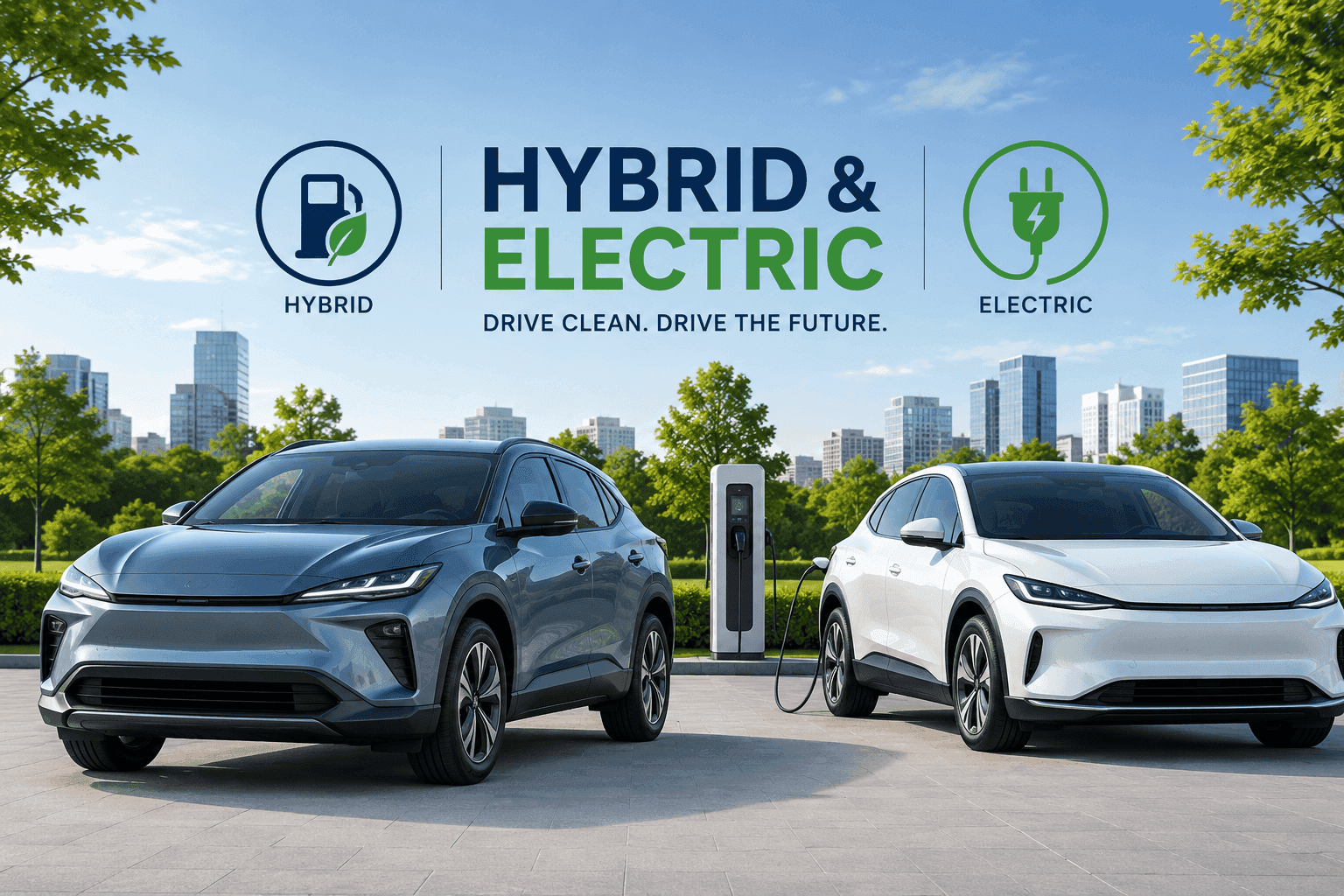
Many O’Fallon drivers are comparing monthly fuel bills, winter usability, and long-term maintenance before replacing their current car. For anyone weighing the question of Should I choose an Electric or Hybrid Vehicle, the right answer usually comes down to charging access, daily mileage, and how often you rely on highway travel outside town. This guide explains how an electric vehicle, a battery electric vehicle, a plug-in hybrid, and a conventional hybrid differ in real use so you can match the powertrain to your routine instead of buying on hype.
If you have reliable home charging, predictable local driving, and modest weekly mileage, an EV often makes the strongest financial case because electricity usually costs less per mile than gasoline. Kelley Blue Book and Consumer Reports both point to lower routine maintenance and strong around-town efficiency as reasons many drivers prefer electric models for commuting.
If you live in an apartment, drive long highway distances, or want to avoid any concern about charging infrastructure, a hybrid is usually the safer fit. In O’Fallon, range anxiety is less about advertised range and more about whether your real schedule includes winter weather, highway commuting, and last-minute trips that make charging logistics feel like a burden.
An EV shines in stop-and-go traffic because instant torque makes low-speed acceleration smooth, and regenerative braking recovers energy that a gas car would waste as heat. KBB regularly notes that city-style driving is where electric ownership feels easiest, because short trips and overnight charging align well.
A hybrid still improves efficiency in town, but it cannot match the quiet, all-electric feel of a full EV during short errands. Its advantage is simplicity, since you can refuel anywhere and never need to think about charger compatibility or charging schedules.
Drivers who spend a lot of time on Interstate routes often prefer a hybrid or HEV because refueling takes minutes and gas stations remain universal. That convenience matters more than theoretical efficiency when your schedule has little room for charging stops.
An EV can still work well for long trips if you are comfortable planning around fast chargers and building charging time into the drive. The tradeoff is that successful EV road-tripping depends more on route discipline than many first-time buyers expect.
A hybrid uses a gasoline engine and an electric motor, but you never plug it in because the battery recharges through the engine and regenerative braking. A plug-in hybrid adds a larger battery that can power short trips on electricity alone before switching to gasoline, while a fully electric vehicle runs only on battery power and has no gas engine at all.
Regenerative braking works by turning the motor into a generator during deceleration, which sends energy back to the battery instead of wasting it. That matters because the same basic principle improves efficiency across hybrids, PHEVs, and EVs, but the daily driving experience changes significantly depending on battery size and whether gasoline remains part of the system.
A hybrid electric vehicle, or HEV, charges itself through braking energy and engine operation, so ownership feels close to a normal gas car. Consumer Reports has repeatedly highlighted hybrids as practical transition vehicles because they cut fuel use and CO2 emissions without asking drivers to change parking or charging habits.
Many experts consider hybrids to be a transitional technology, offering a practical step between conventional gasoline cars and fully electric vehicles. This approach allows drivers to benefit from improved efficiency and reduced emissions while the charging infrastructure and battery technology for full EVs continue to develop.
This setup works best for people who want better mpg and lower emissions with minimal disruption. The biggest advantage is that efficiency gains show up immediately, even if your home or workplace offers no charger access.
A PHEV can cover many short errands on electricity, then operate like a hybrid once the battery is depleted. That dual nature makes it attractive for households that can charge at home but still want unrestricted road-trip flexibility.
The catch is behavioral: a plug-in hybrid only delivers its best savings if you actually plug it in consistently. Buyers who skip charging often end up carrying extra battery weight without getting the electric-mile benefit they paid for.
A BEV, also called an EV, runs entirely on stored battery energy and eliminates tailpipe emissions because there is no engine or fuel tank. The ownership upside is fewer moving parts, no oil service, and a quieter drivetrain, but the practical requirement is dependable charging access.
Real-world range varies by model, speed, terrain, temperature, and driving style, which is why shopping by EPA number alone can mislead buyers. A BEV makes the most sense when your actual routine fits comfortably inside its usable range buffer.
The EPA range is the official estimate of how far an electric vehicle can travel on a full charge, as determined by standardized testing from the Environmental Protection Agency. While this number provides a useful benchmark for comparing different models, it is important to remember that actual range can be lower or higher depending on your driving habits, weather, and terrain. Use the EPA range as a starting point, but always consider your real-world needs and add a buffer for unexpected detours or seasonal changes.
The fastest way to choose is to audit your real week, not your ideal week. A buyer who maps school runs, errands, commuting, and weekend trips will usually see quickly whether overnight charging opportunity or fueling flexibility matters more.
Your decision should also account for the trips that cannot fail, such as emergency drives, airport runs, or recurring family visits. Those edge cases often determine whether a battery-first lifestyle feels easy or stressful.
Check how many miles you drive on a typical day and compare that figure with the real-world range of the vehicles you are considering. An EV fits best when daily miles sit well below available range, which leaves margin for detours, weather, and battery aging.
Then look at where the car sits overnight, because parked time is charging time. A hybrid does not need that window, but an EV becomes far more convenient when it can recover its daily use while you sleep.
Highway driving uses energy faster than many buyers expect because sustained speed reduces efficiency in both EVs and hybrids. For EV shoppers, frequent highway travel means charging stops need to be part of the plan rather than an occasional exception.
Hybrids preserve convenience here because refueling is quick and fuel is available almost everywhere. That broad infrastructure advantage remains one of the strongest arguments for hybrids in mixed local-and-regional driving.
Winter changes the math, especially for EVs. Cold weather range reduction happens because batteries are less efficient at low temperatures and cabin heating draws additional energy, so O’Fallon buyers should evaluate winter range, not just mild-weather estimates.
Hybrids also lose some mpg in winter, but the impact is usually easier to absorb on long trips because gasoline refueling remains fast. Seasonal predictability is one reason cautious buyers often prefer hybrids over EVs in colder climates.
The best value is not always the cheapest sticker price. Total cost of ownership depends on incentives eligibility, financing, local energy prices, maintenance, insurance, and how long you plan to keep the vehicle.
Depreciation is another major factor that affects the total cost of ownership. EVs and hybrids can depreciate at different rates depending on market demand, battery technology, and available incentives. While some electric models have held their value well, others may lose value more quickly due to rapid advancements or concerns about battery replacement costs. Researching typical depreciation rates for the specific models you are considering can help you make a more informed financial decision.
Resale value is closely tied to depreciation and can vary significantly between electric and hybrid vehicles. Factors such as battery health, warranty transferability, and the pace of new technology releases can influence how much your vehicle is worth when you decide to sell or trade it in. Checking recent resale trends for the models you are considering can help you estimate future value and avoid unexpected losses.
EVs often cost more upfront but less to operate, while hybrids usually ask for a smaller initial commitment and still deliver meaningful fuel savings. The financially correct choice depends on whether your usage pattern is strong enough to recover the price difference.
An EV’s upfront cost may be offset by a federal tax credit, but eligibility depends on the specific model, assembly rules, battery sourcing, and your tax situation. That means shoppers should verify current federal tax credit status before assuming a lower effective purchase price.
Hybrids often come in below comparable EVs on initial price, while PHEVs frequently land somewhere in the middle. If budget certainty matters more than maximum fuel savings, the lower upfront cost of a hybrid can be the deciding factor.
EVs usually have a lower cost per mile when home electricity rates are favorable and most charging happens off public networks. That advantage shrinks if you rely heavily on expensive public fast charging, so local utility pricing matters more than broad national averages.
Hybrids reduce fuel spending through strong mpg, especially in stop-and-go traffic where regenerative braking helps. They rarely beat a home-charged EV on pure energy cost, but they often deliver more predictable savings for drivers without stable charging access.
EVs eliminate oil changes, spark plugs, and many engine-related service items, which reduces routine maintenance over time. However, heavier curb weight and strong torque can increase tire wear, so lower service complexity does not mean every ownership cost disappears.
Hybrids still need engine maintenance because they retain conventional mechanical systems. Their long-term complexity is higher than a pure EV because they combine electric components with gasoline hardware in one vehicle.
Charging convenience determines whether an EV feels effortless or inconvenient. Before buying, confirm where and how you will charge, because ownership satisfaction depends more on routine access than on the vehicle’s brochure range.
Level 1 charging uses a standard household outlet, Level 2 uses a 240-volt setup for faster home or workplace charging, and DC fast charging is mainly for travel. The practical lesson is simple: most successful EV ownership starts with dependable home or work charging, not public charging alone.
Check whether you have dedicated parking, outlet access, and enough electrical capacity to add a 240-volt circuit if needed. A garage or driveway with consistent access usually makes EV ownership far easier than shared parking does.
Also budget for installation, permits, and possible panel upgrades. Charger hardware is only part of the cost, and the home setup often determines whether your charging routine stays simple for years.
Review charging station availability along your regular routes, near shopping areas, and on the trips you actually take. Public charging works best as a supplement, not as the sole foundation of ownership, unless your daily routine already aligns with reliable stations.
Pay attention to speed, uptime, and peak-hour congestion rather than just map density. A charger that exists but is often occupied or slow creates the kind of friction that pushes many apartment dwellers toward hybrids instead.
An EV feels different immediately because electric motors deliver instant response, quiet operation, and often one-pedal driving through stronger regenerative braking. That character improves urban comfort, but it does not automatically make an EV better for every household.
A hybrid feels more familiar because refueling is quick and total range is usually longer, while still improving fuel efficiency over a nonhybrid. Practical tradeoffs such as cargo layout, battery placement, and towing limits remain highly model-specific, so powertrain alone does not tell the full story.
Drive the route you know best if the dealer allows it. A real commute reveals more about cabin noise, acceleration, brake feel, and stop-and-go smoothness than a short loop near the showroom.
Also test driver-assist systems in traffic if possible. Features such as adaptive cruise control and lane centering can matter as much as the powertrain for everyday comfort.
EVs ask for more planning because charging takes longer than pumping gas, even on fast chargers. That planning burden may feel minor to organized commuters and very annoying to spontaneous travelers.
PHEVs sit in the middle because they can cut gasoline use without requiring perfect charging coverage. For many uncertain buyers, that middle ground is useful precisely because it limits lifestyle risk.
Reliability concerns are valid, but they should be specific rather than generic. Modern EV and hybrid systems are often durable, yet battery health, software support, and repair networks vary by model and manufacturer.
Battery aging is usually gradual, not sudden failure at a fixed anniversary. The practical issue after several years is often reduced electric range, not an unusable vehicle, which is why warranty terms and real-world owner data matter so much.
Most EVs and many hybrids include long battery warranties, often around eight years, though mileage limits and coverage definitions differ. Buyers should read the exact warranty language because “8 years” usually refers to defect or capacity thresholds, not a promise of unchanged range.
Degradation tends to happen slowly and is influenced by heat, charging habits, and usage patterns. A used EV with some range loss may still be an excellent commuter car if its current range matches your routine.
Insurance premiums can be higher on some EVs and hybrids because parts, sensors, and battery-related repairs may cost more after a crash. That means insurance should be priced before purchase, not treated as a minor afterthought.
Ask carriers for VIN-based quotes on the exact trims you are considering. Model-specific repair data often changes the comparison more than the label “EV” or “hybrid” does.
The biggest buying mistakes are usually practical, not technical. People choose the wrong powertrain when they overestimate convenience, underestimate winter or highway penalties, or ignore the full ownership budget.
A good decision comes from matching the vehicle to your infrastructure and habits. The wrong decision usually starts with assumptions based on marketing, gas prices, or a single test drive.
Gasoline prices move constantly, so they are a weak foundation for a long-term purchase. Your electricity rate, annual mileage, and charging access will usually matter more over several years than any short-term spike at the pump.
Use a simple break-even estimate before buying. Compare your likely monthly fuel or charging cost, insurance, maintenance, and purchase price difference instead of relying on intuition.
Hybrids vary widely in tuning, acceleration feel, and brake response, so one model should not stand in for the whole category. A short drive can quickly reveal whether the transition between electric and gas power feels seamless or distracting to you.
PHEVs also require honesty about charging behavior. If you will not plug in regularly, a standard hybrid often makes more financial sense.
O’Fallon drivers usually fit into a few repeatable patterns, and those patterns point clearly toward one powertrain or another. A weekly mileage log and a charging check are often more useful than any online debate because they expose what your household actually needs.
If you live or work in the WingHaven area, your decision may be influenced by the neighborhood’s mix of residential, business, and retail destinations. WingHaven offers a range of amenities and often features newer infrastructure, which can mean better access to public charging stations and more predictable local driving patterns. These factors can make both EV and hybrid ownership more convenient for residents and commuters in WingHaven compared to some other parts of O’Fallon.
The best choice is the one that handles your normal week with the least friction and the lowest realistic cost. That standard often produces a clearer answer than chasing the newest technology.
If you have driveway or garage parking and a steady commute, an EV is often the cleanest long-term fit. Level 2 home charging, lower routine maintenance, and strong local efficiency make daily ownership simple.
If you rely on street parking or an apartment lot, a hybrid is usually the lowest-friction option. A PHEV only makes sense if workplace charging is dependable enough to support regular electric driving.
If you make regular regional trips, a hybrid or PHEV usually balances efficiency with flexibility. An EV can still work, but only if you are comfortable planning around fast-charging stops and seasonal range variation.
It depends on charging access and driving patterns. If you can charge reliably at home and mostly drive locally, an EV often costs less to run; if you road-trip often or cannot charge consistently, a hybrid is usually easier.
Most hybrids are not being discontinued across the market. Many automakers are expanding hybrid lineups because hybrids remain popular as a bridge between gasoline vehicles and full EVs.
Most EVs remain usable after 8 years, but battery capacity may decline and reduce range. Warranty coverage often protects against certain battery failures or excessive degradation, so check the exact model terms.
It can be, but pricing varies by model, trim, repair costs, and insurer. Get VIN-based quotes for the hybrid and EV versions you are considering before you decide.
If your O’Fallon routine includes home charging and mostly local driving, an EV usually offers the strongest day-to-day efficiency and the simplest maintenance picture. If your schedule depends on flexibility, long highway trips, or parking without charger access, a hybrid will often serve you better with fewer compromises.
Many drivers are choosing hybrid and electric vehicles because they offer lower fuel costs, modern technology, quieter driving experiences, and reduced emissions. Rising gas prices and expanding charging infrastructure have also increased interest in EV ownership.
Hybrid vehicles use both gasoline and electric power, while electric vehicles rely completely on battery power and do not use gasoline at all.
Traditional hybrid vehicles recharge automatically while driving and braking, so they do not need to be plugged in. Plug-in hybrid vehicles can be charged externally for additional electric driving range.
Yes. Electric vehicles can reduce ownership costs by lowering fuel expenses and eliminating many traditional maintenance services like oil changes.
Yes. Hybrid vehicles continue to grow in popularity because they provide excellent fuel economy without requiring drivers to change their fueling habits.
Most EV batteries are engineered to last many years, with many manufacturers offering long-term battery warranty coverage for added peace of mind.
Charging speed depends on the charger type. Fast chargers can provide substantial battery charging in under an hour, while home charging typically happens overnight.
No. Many EV owners simply plug in their vehicle at home overnight, similar to charging a smartphone.
Yes. Most drivers travel far less than modern EV range capabilities each day, making electric vehicles practical for commuting, errands, and daily transportation.
If an EV battery becomes depleted, roadside assistance can transport the vehicle to a charging station or provide emergency charging support depending on the provider.
Yes. Modern EVs are designed for both city and highway travel, offering strong acceleration and smooth high-speed driving performance.
Hybrid vehicles are often preferred for long-distance travel because they combine excellent fuel economy with traditional gasoline refueling convenience.
Electric motors deliver instant torque, allowing EVs to accelerate rapidly and smoothly from a stop.
Yes. EVs operate in both hot and cold climates, although extreme temperatures can temporarily affect battery efficiency and driving range.
Repair costs vary depending on the model and repair type, but EVs often require less routine maintenance compared to gasoline-powered vehicles.
Hybrid vehicles still require regular tire rotations, brake inspections, fluid checks, and oil changes because they use gasoline engines.
Electric vehicles typically require less maintenance because they have fewer moving mechanical components than traditional vehicles.
Yes. EVs operate much more quietly than gasoline vehicles because they do not use traditional combustion engines.
Many modern electric trucks and SUVs are capable of towing trailers, boats, and recreational equipment.
Yes. Hybrid SUVs are popular with families because they combine fuel efficiency, spacious interiors, and advanced safety technology.
Benefits may include:
Electric vehicle ownership may include:
Regenerative braking captures energy normally lost during braking and uses it to help recharge the battery.
Yes. Public charging infrastructure continues expanding across cities, highways, shopping centers, and workplaces throughout the United States.
Yes. Home charging is one of the biggest conveniences of EV ownership.
Level 1 charging uses a normal household outlet, while Level 2 charging uses faster 240-volt equipment that significantly reduces charging time.
Electric vehicles produce zero tailpipe emissions and can help reduce dependence on fossil fuels.
Hybrid vehicles reduce gasoline consumption and emissions compared to many traditional gas-powered vehicles.
Yes. Many EV battery materials can be recycled and reused for future battery production and energy storage applications.
Consumer demand for fuel-efficient and environmentally friendly transportation options continues to grow rapidly.
Yes. Both hybrids and EVs are extremely popular commuter vehicles because they help reduce fuel costs and improve efficiency.
Some electric vehicles may qualify for federal, state, or local incentives depending on eligibility requirements.
Yes. Plug-in hybrid vehicles can switch to gasoline power once the electric driving range is depleted.
Buyers should consider:
Drivers should compare:
Yes. Electric pickup trucks are growing in popularity because they combine towing capability, technology, and zero-emission driving.
Drivers with long commutes, frequent highway driving, or limited access to charging stations often benefit greatly from hybrid ownership.
Drivers with shorter daily commutes and convenient home charging often enjoy the biggest advantages from EV ownership.
Yes. Battery technology, charging speeds, driving range, and public charging infrastructure continue improving every year.
Automakers are responding to consumer demand, fuel efficiency goals, and advancements in battery and charging technology.
Most automotive manufacturers continue investing heavily in electric vehicle development as the industry moves toward electrification.